
- Clear Aligners at TEETH @ Tiong Bahru
Invisalign® for Kids
treatment & costs
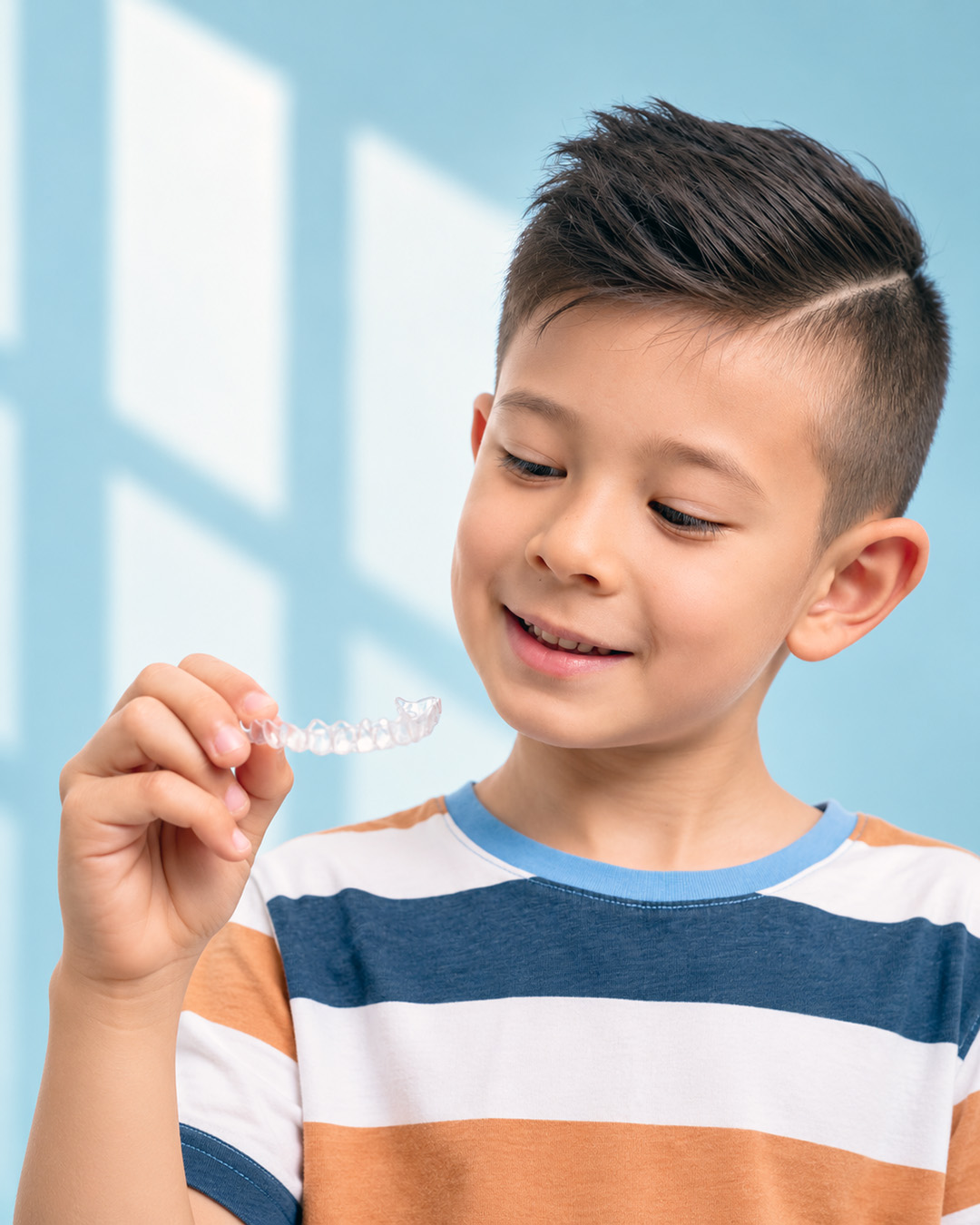
Invisalign First™ is a clear-aligner treatment for selected children who have baby and adult teeth. This form of Invisalign for kids is commonly considered between ages 6 and 10, but a child’s dental development matters more than their ages. Whether it is Invisalign versus braces for children, a proper dental assessment matters more than an arbitrary age marker.
Invisalign First removable clear aligners create room for erupting adult teeth and manage selected orthodontic issues, including crowding, spacing, narrow dental arches, and bite problems. Suitability for kids’ Invisalign treatment depends on your child’s teeth, bite, growth, oral health, and ability to wear the aligners consistently.
- The appliance
What Is Invisalign First?
Invisalign First is the child-focused form of Invisalign treatment designed for Phase 1 orthodontic treatment.
A series of custom aligners applies staged pressure to selected teeth. Invisalign First treatment plans can accommodate baby teeth, spaces and permanent teeth that are still erupting.
Treatment with clear aligners for kids may aim to:
- Create space for incoming permanent teeth.
- Develop selected dental arches.
- Straighten crowded or rotated teeth.
Reduce unwanted gaps. - Address selected crossbites, open bites, overbites or underbites.
Invisalign First cannot correct every orthodontic issue or jaw problem. Some children may need traditional braces, another appliance, specialist assessment, or a combination of treatments.
| Treatment detail | What to expect |
|---|---|
| Appliance | Custom, removable clear aligners for children in mixed dentition |
| Common age range | About 6 to 10, depending on dental development |
| Daily wear | Usually 20 to 22 hours, or as prescribed |
| Aligner changes | Usually every 1 to 2 weeks, as prescribed |
| Review visits | Often every 6 to 8 weeks, depending on the treatment plan |
| TEETH price | $3,270 to $9,285, including 9% GST |
| After treatment | Retainers, monitoring or a later phase of orthodontic treatment may be needed |
- Assessment
When Should a Child Have an Orthodontic Assessment?
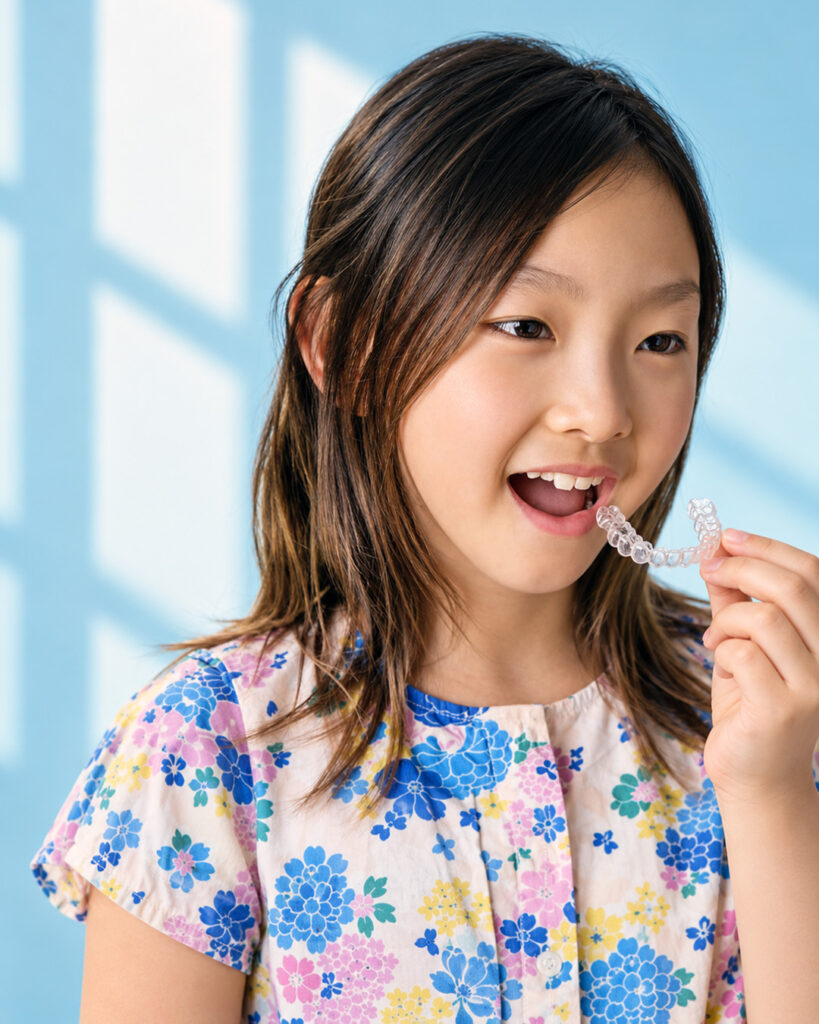
We recommend a child orthodontic assessment by age seven. This does not mean every seven-year-old needs Invisalign treatment, traditional braces or an early intervention.
An early assessment may be appropriate if you notice:
- Crooked teeth, crowded teeth, overlapping teeth or wide spaces
- A crossbite, underbite, open bite or pronounced overbite
- Protruding front teeth
Teeth that are not erupting as expected - Uneven jaw movement or facial asymmetry
- Difficulty biting or chewing
See the wider range of conditions orthodontic treatment may address, including other mild or moderate orthodontic issues.
Who May Be Suitable for Invisalign First?
Traditional braces for kids may be more suitable when continuous wear is important, aligner compliance is uncertain, or the required movements aren’t reliable with clear aligners. Younger children may need more supervision, which is one factor to consider when choosing removable aligners for children. Invisalign First for children may be suitable when:
The stage of tooth eruption fits the planned treatment.
The required tooth and arch movements can be achieved with clear aligners.
The child’s dental health is suitable for orthodontic treatment.
Oral hygiene during treatment can be maintained.
The aligners can be worn for the prescribed hours each day.
The child can remove, clean and store the trays responsibly.
A parent or caregiver can help supervise daily wear.
- The Process
What Happens During Treatment?
At the initial consultation, the dentist will assess your child’s teeth, gums, bite and jaw relationship. They will discuss your concerns, treatment options, and your child’s ability to manage removable clear aligners.
Photographs, X-rays and a digital scan or dental impressions may be required. A digital scan will create a three-dimensional model for diagnosis and aligner planning.
During the treatment, the dentist will plan the proposed movements and explain the expected treatment duration, limitations, material risks, alternatives, and the required fees. The digital simulation will not guarantee the result but will guide treatment.
We will check the first clear aligners for fit. Your child will be shown how to insert, remove, clean and store the aligners. Tooth-coloured attachments or elastics may be required.
Invisalign aligners are generally worn for 20 to 22 hours each day and changed every 1 to 2 weeks, or as prescribed. Effective treatment will depend on consistent aligner wear. Your dental specialist will communicate that to your child.
Reviews are often arranged every 6 to 8 weeks. The dentist will check the fit, tooth movement, oral health, and the eruption of permanent teeth. A new scan and additional Invisalign aligners may be needed if your child’s teeth do not move as planned.
Retainers will help limit unwanted movement after active treatment. Some children may later need Phase 2 orthodontic treatment when more adult teeth have erupted.
- Duration
How Long Does Invisalign First Take?
There is no standard duration for every child, as every child requires different treatment. Invisalign treatment time depends on the problem being treated, the planned movements, the tooth eruptions, biological responses, daily wear, lost aligners and whether refinements are needed.
The dentist can provide an estimate after the assessment and digital records. This estimate is a guide, not a guaranteed completion date, and you should communicate that clearly to your child.
Benefits and Limitations
Potential benefits of Invisalign clear aligners include:
- Invisalign aligners are less noticeable than traditional metal braces, but they are not always virtually invisible.
- They can be removed for eating.
- Children can brush and floss without fixed metal brackets or wires in the way.
- Unlike traditional braces, there are no archwires or metal brackets that can loosen or rub the inner cheeks.
These benefits of Invisalign depend on your child following the treatment plan.
Important limitations include:
- Treatment depends on consistent daily wear.
- Removable Invisalign aligners can be lost or damaged.
- Attachments and elastics may be visible.
- Tray edges or attachments may irritate the lips, your child’s mouth or tongue.
- Temporary speech or saliva changes can occur.
Eating and Cleaning with Invisalign
Removability can make oral hygiene easier, but the aligners and teeth still need regular cleaning. Your child should:
- Remove the Invisalign aligners for meals and drinks other than plain water.
- Brush twice daily with a fluoride toothpaste.
Floss daily. - Clean their teeth before replacing the aligners when practical.
- Clean the clear aligners as directed by the dentist.
Avoid hot water, which may distort the aligners.
Store the removed aligners in their case.
There are no aligner-specific food restrictions, as your child will take off the aligners before eating. Contact the clinic if an aligner is lost, cracked, painful, or no longer fits. Do not move to another set unless the dentist advises it.
- Making the choice
Invisalign First or Braces for a Child?
Neither option suits every child. Invisalign First clear aligners and traditional braces work differently. The required movements, dental development and ability to follow the treatment plan should guide the choice. Traditional braces may provide more predictable control for some movements.
| Consideration | Invisalign First | Fixed braces |
|---|---|---|
| Wear | Removable and dependent on consistent daily wear | Fixed to the teeth and works continuously |
| Eating | Removed for meals | Certain hard or sticky foods may need to be avoided |
| Cleaning | Removed for brushing and flossing | Cleaning is required around brackets and wires |
| Visibility | Clear but not completely invisible | Metal braces are visible; ceramic options are less noticeable |
| Suitability | Selected mixed-dentition cases | May provide more predictable control for some movements |
| Reviews | Regular clinical reviews are required | Regular clinical reviews are required |
- Transparent pricing
How Much Does Invisalign for Kids Cost in Singapore?
Invisalign for kids at TEETH @ Tiong Bahru costs between $3,270 and $9,285, including 9% GST.
Your child’s fee depends on the treatment plan and case complexity. Ask for a written estimate stating whether it includes:
- The consultation and dental records
- X-rays and digital scanning
- Review visits
- Attachments and elastics
- Refinement or replacement aligners
- Retainers
- Any dental treatment needed before orthodontic care
- Contact Us
Invisalign Assessments for Children
An initial assessment determines whether your child needs treatment now, monitoring, or another orthodontic approach. The dentist will review the tooth eruption, dental-arch development, bite, oral health and your child’s readiness to manage removable clear aligners.
At TEETH @ Tiong Bahru, we offer Invisalign for kids in Singapore and tailored dental care throughout the process. If you are looking for Invisalign First in Singapore, book an appointment for your child.
- Good to know
Common frequently asked questions about braces
Every child’s mouth is different. These answers are general. Your child’s assessment at TEETH @ Tiong Bahru covers what applies to them.