
- early orthodontic treatment
Braces for Kids in Singapore
Braces are orthodontic appliances that gradually improve alignment and how the upper and lower teeth meet. The right age for braces for kids can vary. Some children need early braces treatment while their baby teeth are still present. Others start orthodontic treatment after most of their adult teeth have erupted.
An orthodontic check at around 7 years old can identify crooked teeth, crowding, bite problems, unusual tooth eruption or concerns about jaw growth. This does not mean every child needs dental braces at age 7. The right time depends on the problem, dental development, growth and your child’s ability to care for the appliance.
- types of braces for kids
When Should a Child Have an Orthodontic Assessment?
Orthodontists typically recommend an initial assessment around age 7 because children usually have a mix of baby and permanent teeth at this stage. Before then, an orthodontic assessment may not be helpful because the child’s mouths will still be changing. The dentist or orthodontist may recommend braces, monitoring, or another review as the mouth develops. Readiness varies among young patients.
Ask for an earlier assessment if you notice a jaw that shifts when your child bites, a bite that does not close normally, difficulty biting or chewing, an adult tooth that is not emerging as expected, protruding front teeth that may be at risk of injury, or persistent mouth breathing.
Many children start care in early adolescence, after enough permanent teeth have appeared. Treatment may begin earlier or later if needed.
- Braces for Children
How Can I Tell if My Child May Need Braces?
Signs of dental misalignments or a poor bite, sometimes called a bad bite, may need an orthodontic assessment to treat certain conditions with braces:
- Crowded teeth, crooked teeth or rotated teeth.
- Large gaps or adult teeth that are missing or not emerging as expected.
- Protruding upper front teeth.
- An underbite, crossbite, open bite or deep bite.
- A jaw that appears uneven or moves to one side when closing.
- Difficulty biting or chewing.
- Early permanent tooth loss, or a late loss of baby teeth.
- A prolonged thumb or finger sucking habit that affects the bite.
These signs do not confirm that the child will need braces. Crooked teeth and other changes may be part of the child’s normal dental development.
What Are Phase 1 and Phase 2 Orthodontic Treatment?
Younger children do not need to lose all their baby teeth before they begin treatment. Interceptive braces treatment, or early intervention, is used only for selected problems.
The treatment may have one or two stages.
- Phase 1 treatment takes place while the baby and permanent teeth are both present. It is used for selected problems that may benefit from early management, such as certain crossbites, marked jaw discrepancies, a severe lack of space, harmful oral habits, or protruding front teeth at risk of injury. Treatment may involve an expander, a removable or functional appliance, space management or limited dental braces.
- Phase 2 braces treatment usually begins after most permanent teeth have erupted. Traditional braces or clear aligners for kids may improve alignment and refine the bite.
Early treatment does not guarantee that full braces, extractions or jaw surgery will be avoided later. For some kinds of alignment issues, it may simplify later orthodontic care. For others, monitoring until the appropriate stage is the better approach.
What Types of Braces Are Available for Kids?
The type of braces for kids depends on the treatment plan, which adjusts to the required tooth movements, the child’s dental development, oral hygiene, daily routine, and ability to follow instructions.
| Types | What parents should know |
|---|---|
| Traditional metal braces | Stainless steel brackets and wires remain fixed to the teeth and work continuously. They are durable and can manage a wide range of tooth and bite movements. |
| Ceramic braces | Tooth-coloured or clear brackets are less noticeable, which may matter more for teenagers concerned with aesthetics. Ceramic brackets are more brittle than metal, and clear elastic ties may discolour. |
| Self-ligating braces | A built-in clip holds the wire instead of an elastic ligature. Research has not consistently shown that these self-ligating braces shorten overall treatment or cause less pain than conventional braces. |
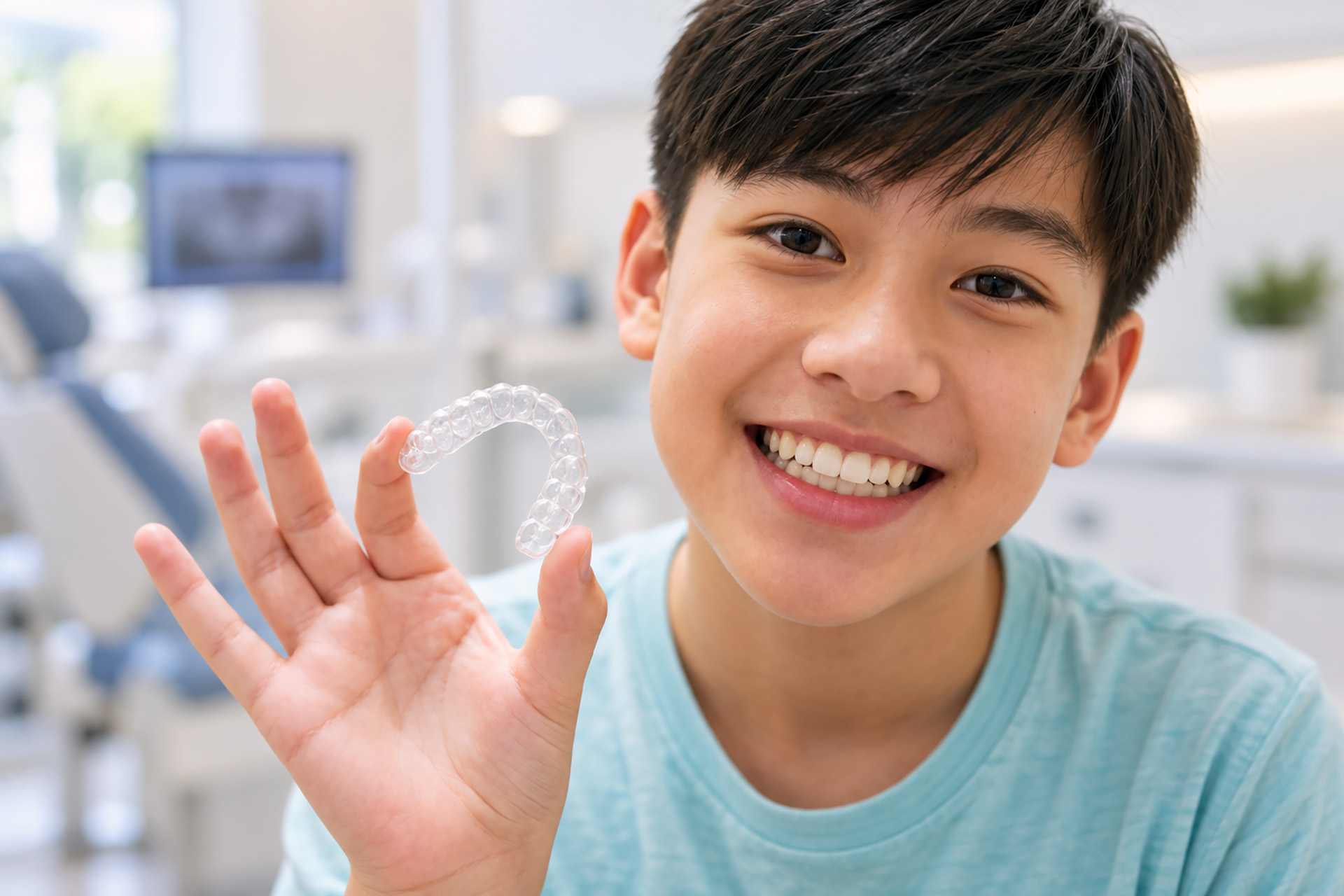
| Clear aligners | Removable trays may suit selected children and teenagers who can wear and care for them as prescribed. They are sometimes known as invisible aligners, though they are not completely invisible. Some complex movements need attachments, elastics or fixed appliances. Invisalign First™ is intended for selected children in mixed dentition, while Invisalign® Aligners for Teens is designed for adolescents. |
| Lingual braces | These fixed braces sit behind the teeth. They are less visible but can be harder to clean and may affect the tongue or speech at first. They are less commonly chosen for children as they require more discipline for good oral hygiene. |
How Do Braces Move Teeth?
Dental braces apply light, controlled forces. Traditional braces apply continuous pressure. The jawbone remodels around the roots, allowing appliances to gradually shift teeth. Removable trays apply staged pressure. This teeth-straightening process guides teeth alignment.
Teeth straightening can align misaligned teeth and improve many bite issues. Orthodontic appliances cannot correct every jaw-position difference on their own. A child with a marked skeletal or developmental problem may need specialist assessment or treatment involving other appliances or, later, jaw surgery.
- The process
What Happens during Braces Treatment?
Assessment and records. The dentist will complete a thorough examination of the mouth, gums, bite and jaws. Photographs, X-rays and a digital scan or impressions may be needed.
Treatment planning. Before orthodontic treatment begins, you and your child will receive an explanation of the diagnosis, the treatment options, timing, expected duration, material risks and fees. The dentist will also consider your child’s psychological readiness and ability to manage cleaning or aligner wear.
Preparation. The dentist will first manage tooth decay and active gum disease. Some children may need an orthodontic tooth extraction to create space, but many do not.
Appliance fitting. We will bond metal or ceramic brackets to the teeth and connect them with an archwire, or fit the first clear aligners. We may prescribe additional attachments or elastics.
Reviews. Regular appointments will check tooth movement, the appliance and oral health. We often review braces every 4 to 8 weeks. The schedule will vary with the treatment plan.
Removal and retention. When active treatment is complete, we remove the brackets or end active aligner wear. Retainers will then help limit unwanted tooth movement.
How Should Children Care for Braces?
Brackets and wires create areas where food and plaque can collect. Good oral hygiene habits protect your child’s teeth while wearing braces and support your child’s oral health. Good hygiene also lowers the risk of tooth decay, white enamel marks, and gum disease.
- Regular brushing and interdental cleaning are important. Dental checkups help catch gum recession.
- Brush for at least two minutes twice a day with fluoride toothpaste. Clean above, below and around each bracket.
- Clean between the teeth and beneath the wire every day using floss, a floss threader or an interdental brush as advised.
- Continue routine dental care, including check-ups during orthodontic treatment.
- Avoid hard, sticky and very chewy foods that can loosen brackets or bend wires. Cut firm foods into smaller pieces.
- Limit sugary foods and drinks, especially between meals.
- Wear prescribed rubber bands or aligners for the stated time.
- Report lost aligners, broken brackets or displaced wires promptly.
When kids wear braces, parents may need to supervise their dental cleaning until the child can clean thoroughly and consistently without help.
How Long Do Braces for Children Take?
Comprehensive braces treatment often takes about 18 to 24 months. Depending on the problem and the child’s response, it may take about 12 months to 3 years.
Treatment may take longer when tooth movements are complex, the teeth are impacted, the child is still growing, appointments are missed, brackets break, or the prescribed elastics and aligners are not worn consistently. The first estimate is a guide, not a guaranteed completion date, and your child should understand that.
Do Braces Hurt?
Your child may feel pressure or tenderness for a few days after braces are fitted or adjusted, especially when they first start wearing braces. Brackets can also rub the cheeks or lips initially, which is where orthodontic wax can help. Ask your dentist before giving pain medicine, and follow the dosing instructions for your child’s age and medical history.
Contact the dental clinic if your child’s pain is severe or persistent, the face or gums are swollen, a tooth becomes unusually loose, or a broken bracket or wire is injuring the mouth.
- Current fees
How Much Do Braces for Kids Cost at TEETH @ Tiong Bahru?
What Happens after the Braces Come Off?
Teeth can move back to their original position after an orthodontic treatment. Your dentist may prescribe a removable retainer, a fixed retainer behind the teeth, or both. Retainers are usually needed long-term, although wear frequency may decrease over time. Follow the schedule given for your child and read more about retainers after braces.
Braces Assessment for Children
- fAQs
Common Frequently Asked Questions
Does my child need braces at age 7?
Not necessarily. An assessment around age 7 can identify developing concerns, but many children only need monitoring. Treatment begins when the type of problem and stage of dental or jaw development make it appropriate.
What is the best age for braces for children?
There is no single best age. Many children start comprehensive braces in early adolescence, after most adult teeth have come in. Selected bite, jaw or eruption problems may benefit from earlier treatment.
Are metal braces or clear aligners better for kids?
Neither is better for every child. Traditional metal braces work continuously and can manage many complex movements. Ceramic braces are another fixed option. Clear aligners are removable and less noticeable, but they depend on consistent wear and may not suit every movement. The diagnosis and your child’s ability to follow instructions should guide the choice of the type of braces for your child.
How much do braces cost for kids in Singapore?
At TEETH @ Tiong Bahru, children’s early orthodontics starts from $2,000; braces are $3,815 to $5,450; and Invisalign clear aligners are $3,270 to $9,285 with GST. The cost of braces depends on the treatment required and what the written estimate includes.
Will my child need a retainer after braces?
Yes. Retainers help hold teeth in place after active movement ends. Long-term wear is often advised because teeth can continue to move. The dentist or orthodontist will prescribe the type of retainer and wear schedule.